

microphones, Products
Shure MV7+, MV6, and MV7i Microphones: A Comprehensive Comparison

Mar
Since its launch in late 2020, Shure’s MV7 (now succeeded by the MV7+) has gained widespread popularity as a podcast microphone, thanks to its user-friendly design and robust feature set. Recently, Shure expanded its lineup with two new additions—the MV6 and MV7i—raising the question of how they compare. What sets them apart, and which one best suits your needs? More choices can be exciting, but they also make decisions trickier. This guide provides all the essential details to help you confidently choose the microphone that’s right for you.
Click here to compare the MV7 and MV7+Common Features and Design of the Shure Microphones
Before diving into the specifics of each model, it’s worth noting the common features and design elements that make Shure microphones stand out. All three models—the MV7+, MV6, and MV7i—are dynamic microphones with cardioid polar patterns, designed to capture sound primarily from the front while rejecting noise from the sides and rear. They share a frequency response of 50 Hz to 15,000 Hz, which is well-suited for vocal applications. Each microphone boasts Shure’s exceptional build quality, with an all-metal construction and an adjustable yoke for easy positioning. Additionally, they all incorporate Shure’s Voice Isolation Technology, which focuses on capturing the user’s voice while minimizing background noise, making them ideal for recording in less-than-ideal acoustic environments.
Moreover, all three microphones include advanced DSP features to enhance audio quality. The Auto Level Mode automatically adjusts gain for consistent levels, while the Real-time Denoiser reduces background noise. The Digital Popper Stopper minimizes plosives, ensuring clean recordings. These features make the microphones user-friendly, especially for those new to audio recording.
Shure MV7+

The Shure MV7+ is a versatile microphone that offers both USB-C and XLR outputs, catering to users who need flexibility in their setup. It features a customizable LED touch panel that serves as both a level meter and a mute button, adding a visual and functional element to the microphone. Advanced DSP features include Auto Level Mode, a digital pop filter, real-time denoiser, and reverb effects, making it a great choice for musicians and podcasters who want to add creative touches to their recordings. Priced at approximately $279, the MV7+ is aimed at professionals who demand high-quality audio and advanced features.
Sound quality-wise, the MV7+ is pretty indistinguishable from the MV7i when using USB-C, but has major differences from the MV6.
Shure MV6
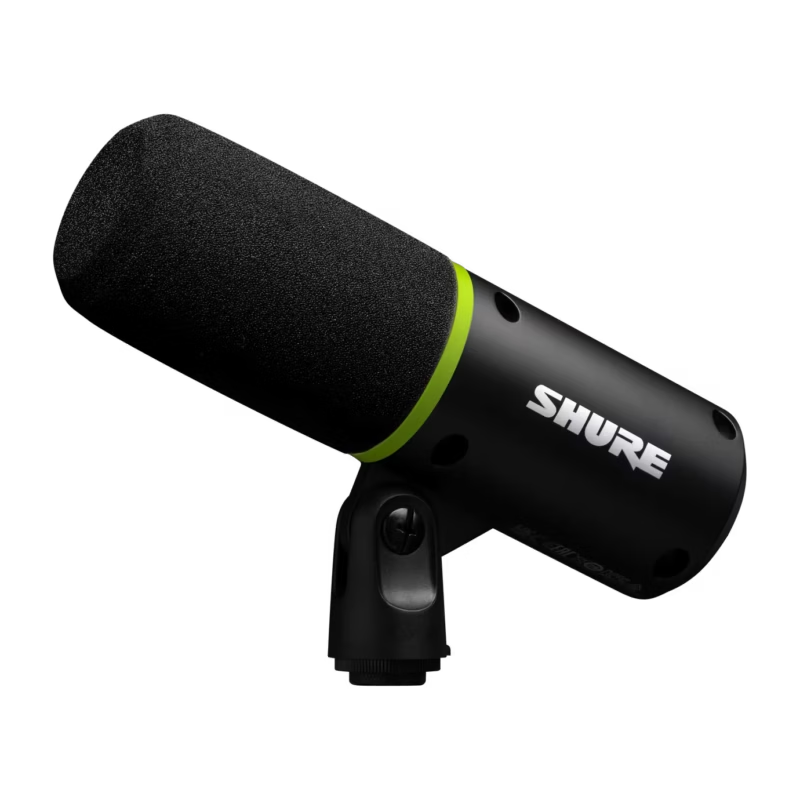
The Shure MV6 is designed for gamers and streamers who need a straightforward, high-quality USB microphone. It connects via USB-C and includes essential DSP features like Auto Level Mode, a Digital Popper Stopper, and a Real-time Denoiser. The MV6 also features Voice Isolation Technology to ensure clear audio capture in noisy environments. At approximately $149, it’s an affordable option that doesn’t skimp on quality.
Differences Between the MV6 and MV7+
- The MV7+ has both USB-C and XLR inputs, while the MV6 only offers USB-C.
- Both models include a real-time denoiser, a digital popper stopper, and a high-pass filter.
- The MV7+ also includes reverb, a limiter, and a compressor.
- Tonality: The MV7+ retains the warm broadcast tone of the iconic SM7, while the MV6 has a brighter sound.
- Price: The MV7+ is significantly more expensive (prices listed at the bottom).
Shure MV7i

The Shure MV7i stands out with its built-in audio interface, allowing for two-channel recording. It features a combo XLR and 1/4” input, enabling users to connect external microphones or instruments directly to the microphone. Advanced DSP features include Auto Level Mode with SmartGate, which dynamically adjusts gain based on proximity and room acoustics, as well as a Real-time Denoiser and Digital Popper Stopper. Priced at $299, the MV7i is ideal for creators who need to record multiple audio sources without additional equipment. An important difference to note between the MV7i and MV7+ is that the MV7i can only connect via USB-C, with its XLR connection being used solely to connect an additional mic.
Additional Differences Between the MV7i and MV7+
- The MV7i connects to your recording device only via USB-C, with its XLR connection used solely to add an additional microphone.
- The MV7i is the only microphone that features SmartGate. SmartGate is a digital signal processing (DSP) feature integrated into the Shure MV7i, part of its Auto Level Mode. It dynamically adjusts microphone gain based on proximity, speech volume, and room acoustics, and reduces the volume of a channel when a user falls silent, minimizing crosstalk. This is particularly useful for dual-channel recording, such as interviews or simultaneous vocal and instrument tracking, ensuring clear, uninterrupted audio.
Can It Power an SM7B?
Yes, you can power an SM7B with your MV7i, with the added benefit of DSP from the MV7i interface.
Use Cases
To better understand which microphone suits your needs, consider the following scenarios:
- Podcasting in a Home Studio: The MV7+ is ideal due to its XLR connectivity, allowing integration with professional audio equipment, and its reverb effects for adding depth to vocal recordings.
- Gaming and Streaming: The MV6 is perfect for its simplicity and affordability, providing high-quality audio without the need for additional hardware.
- Music Recording: The MV7i shines here, with its built-in audio interface allowing simultaneous recording of vocals and instruments.
- Podcasting on the Road: The MV7i is the perfect choice for mobile recording, thanks to its ability to connect two microphones directly to a phone, making high-quality podcasting effortless while traveling.
Conclusion
In summary, Shure’s MV7+, MV6, and MV7i microphones each serve distinct purposes in the content creation landscape. The MV7+ is perfect for professionals who need versatility and creative features. The MV6 is an excellent entry-level option for gamers and streamers. The MV7i is ideal for creators who require multi-source recording capabilities.
If you’re just starting out or have a tight budget, the MV6 is a solid choice. For those who want more control and flexibility, the MV7+ is worth the investment. And if you need to record multiple sources simultaneously, the MV7i is the way to go.
Regardless of which model you choose, you can be confident that Springtree Media Group offers the best price. Just click the big red “My Price?” button on the product page, and we’ll send you a quote. 🙂
Prices


Podcast Microphones
Podcast Microphones


Podcast Microphones
Thanks for reading!